


Page 11 - IJSA, Vol. 7, No 1, 2024
P. 11
International Journal of Science Annals, Vol. 7, No. 1, 2024
                      рrint ISSN: 2617-2682; online ISSN: 2707-3637; DOI:10.26697/ijsa

            Introduction
            Society  has  entered  an  era  of  digitalisation.  This  has   The questionnaire was available on the official website
            opened  up  new  perspectives  for  the  study  and  use  of   of  the  Scientific  Research  Institute  KRPOCH  using
            artificial  intelligence  (Pypenko,  2019).  The  higher   Google                           Forms
            education industry is one of the first sectors of human   (https://docs.google.com/forms/d/e/1FAIpQLSeu0HZ
            endeavour  to  embark  on  digital  transformation   W1t7I5guMH7M_FcTDizHxnpU-
            (Shenkoya & Kim, 2023). The number of studies and   OvPMU1_lCfPF_K9y6g/viewform). The questionnaire
            publications on the use of artificial intelligence (AI) in   was  also  made  available  to  potential  participants  on
            higher education has increased two to three times in the   social networking sites such as Facebook, LinkedIn, etc.
            last five years compared to previous years (Bearman et   A  selective  individualised  online  interview  was  also
            al., 2023; Chu et al., 2022; Crompton & Burke, 2023).    conducted  with  survey  participants,  when  it  was
            The advent of chatbots based on artificial intelligence   necessary to clarify their answers and/or determine the
            (AI chatbots) and specialised in text (Large Language   specifics of their use of AI chatbots.
            Models)  has  been  a  catalyst  and  a  major  factor  in   Statistical analyses were performed using SPSS 28.0.1
            revolutionising higher education. These changes are in   software. Descriptive statistics using frequencies, means
            progress at this moment. The changes affect all elements   and standard deviations were used to analyze the data
            of  the  higher  education  system  and  all  stakeholders   collected. Cronbach’s alpha was used to assess internal
            involved in the process. Today, we are seeing a boom in   consistency.  Cronbach’s  alpha  was  0.837.  This  meets
            the  use  of  various  AI-based  chatbots  by  faculty  and   internal consistency requirements (α>0.7).
            students in the educational process.
            As  a  result,  many  new  questions  arise  about  the   Results
            legitimacy of using AI and adhering to ethical standards   The questionnaire developed consisted of six questions.
            when  using  AI  chatbots  in  education  and  science   It was used to gather information about the possibilities
            (Melnyk  &  Pypenko,  2023).  Therefore,  there  is  an   of  using  AI  chatbots  in  higher  education.  The
            obvious need to study the influence and role of AI in the   questionnaire  consisted  of  an  instruction  sheet
            research  and  teaching  activities  of  professors  and  the   explaining the purpose and conditions of the study and
            learning activities of university students.         six questions, of which three questions characterised the
            The aim of the study. To explore practices and identify   respondent (gender, status, country) and three questions
            trends in the use of artificial intelligence-based chatbots   related to the purpose of the study.
            by stakeholders in higher education.                To explore how stakeholders are using AI chatbots in
                                                                higher education, the following general questions apply:
            Materials and Methods                               A. Does  your  college/university  use  hybrid  learning
            The  study  was  conducted  among  363  students  (175   (face-to-face / distance learning)?
            males and 188 females) and 425 university faculty (198   B. Do you use artificial intelligence-based chatbots to
            males  and  227  females)  from  57  countries  between   prepare  for  classes  or  complete  assignments  at  your
            January  and  April  2024.  The  probability  sampling   college/university?
            method (randomly generated) was used to survey faculty   C. Do  you  edit  the  results  returned  by  generative
            working in hybrid modes in higher education. A similar   chatbots at your request?
            method was used to survey students who were studying   The questions involved the choice of one of the answer
            synchronous  contact  and  distance  learning  or   options “yes” or “no”.
            asynchronous  distance  learning.  The  survey  was   The  key  findings  of  the  study  on  the  use  of  artificial
            voluntary.  Participation  was  anonymous.  Respondents   intelligence-based  chatbots  by  higher  education
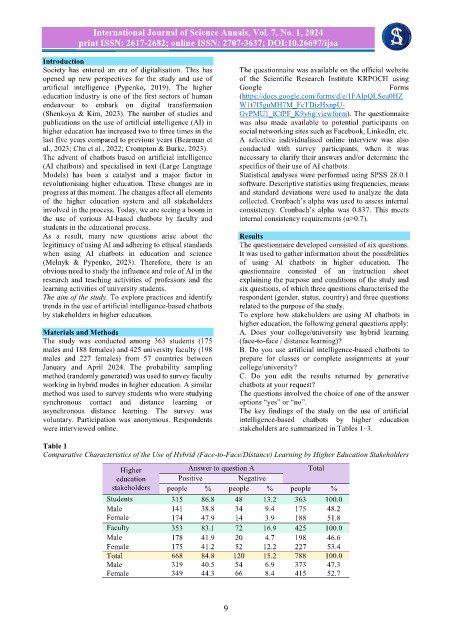
            were interviewed online.                            stakeholders are summarized in Tables 1–3.

            Table 1
            Comparative Characteristics of the Use of Hybrid (Face-to-Face/Distance) Learning by Higher Education Stakeholders

                                 Higher            Answer to question A           Total
                                education       Positive        Negative
                               stakeholders   people   %     people    %      people    %
                             Students         315     86.8     48     13.2     363     100.0
                             Male             141     38.8     34      9.4     175     48.2
                             Female           174     47.9     14      3.9     188     51.8
                             Faculty          353     83.1     72     16.9     425     100.0
                             Male             178     41.9     20      4.7     198     46.6
                             Female           175     41.2     52     12.2     227     53.4
                             Total            668     84.8    120     15.2     788     100.0
                             Male             319     40.5     54      6.9     373     47.3
                             Female           349     44.3     66      8.4     415     52.7


                                                            9

