


Page 13 - IJSA, Vol. 7, No 1, 2024
P. 13
International Journal of Science Annals, Vol. 7, No. 1, 2024
                      рrint ISSN: 2617-2682; online ISSN: 2707-3637; DOI:10.26697/ijsa

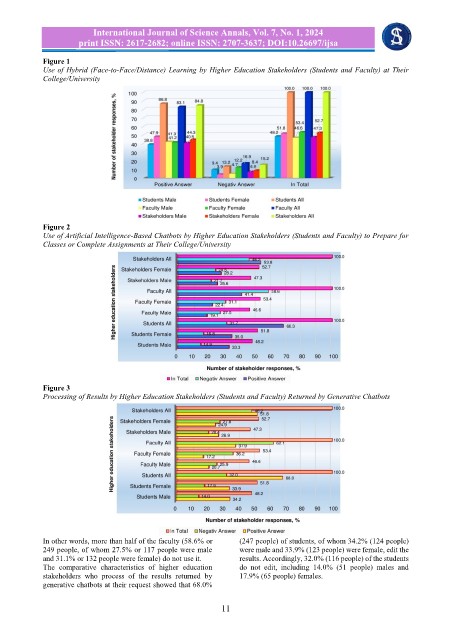
            Figure 1
            Use of Hybrid (Face-to-Face/Distance) Learning by Higher Education Stakeholders (Students and Faculty) at Their
            College/University


            Figure 2
            Use of Artificial Intelligence-Based Chatbots by Higher Education Stakeholders (Students and Faculty) to Prepare for
            Classes or Complete Assignments at Their College/University


            Figure 3
            Processing of Results by Higher Education Stakeholders (Students and Faculty) Returned by Generative Chatbots


            In other words, more than half of the faculty (58.6% or   (247 people) of students, of whom 34.2% (124 people)
            249 people, of whom 27.5% or 117 people were male   were male and 33.9% (123 people) were female, edit the
            and 31.1% or 132 people were female) do not use it.   results. Accordingly, 32.0% (116 people) of the students
            The  comparative  characteristics  of  higher  education   do  not  edit,  including  14.0%  (51  people)  males  and
            stakeholders  who  process  of  the  results  returned  by   17.9% (65 people) females.
            generative chatbots at their request showed that 68.0%

                                                           11

