


Page 16 - IJSA, Vol. 7, No 1, 2024
P. 16
International Journal of Science Annals, Vol. 7, No. 1, 2024
                      рrint ISSN: 2617-2682; online ISSN: 2707-3637; DOI:10.26697/ijsa

            The  results  show  that  there  is  a  positive  correlation   Examining  global  trends  in  the  use  of  AI  and  their
            between  hybrid  learning  and  the  use  of  AI  chatbots   implications  for  changing  educational  paradigms
            among students and faculty.                         highlights the role of collaboration and partnership in
            The results of our study, and the willingness of students   fostering  innovation  that,  by  setting  new  quality
            to use AI chatbots in their education, are consistent with   standards, stimulates the evolution of higher education
            research  on  trends  in  the  potential  application  of  AI-  (Aithal & Maiya, 2023).
            based robots in higher education. Research shows that   With the advent of AI, the modern world has begun to
            students  are  ready  to  use  them  in  their  education   change  rapidly.  And  it  is  highly  likely  that  the  new
            (AlGerafi  et  al.,  2023).  This,  in  turn,  is  a  signal  to   Human-AI  system  will  radically  change  the  rules  of
            university administrators. They should pay attention to   student education in universities (Melnyk & Pypenko,
            the social demands of today’s youth.                2023).
            A  key  benefit  of  using  AI  in  higher  education  is  its   In our view, the main problem with using AI in learning
            ability  to  drive  efficiency,  personalisation  and   and  teaching  in  higher  education  is  getting  the  result
            optimisation of administrative processes (Al Husseiny,   without any human effort. We have presented a model
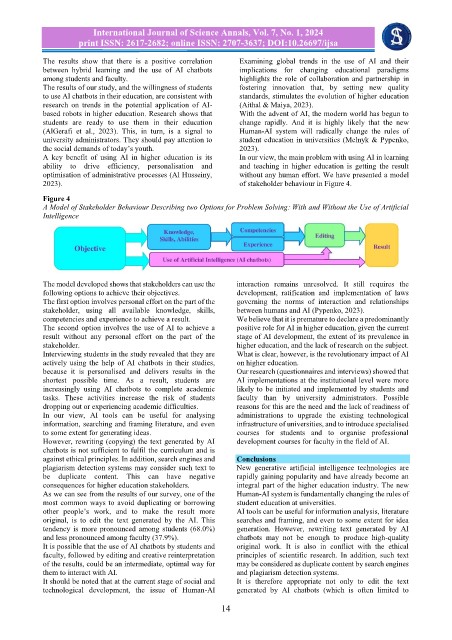
            2023).                                              of stakeholder behaviour in Figure 4.
            Figure 4
            A Model of Stakeholder Behaviour Describing two Options for Problem Solving: With and Without the Use of Artificial
            Intelligence


            The model developed shows that stakeholders can use the   interaction  remains  unresolved.  It  still  requires  the
            following options to achieve their objectives.     development,  ratification  and  implementation  of  laws
            The first option involves personal effort on the part of the   governing  the  norms  of  interaction  and  relationships
            stakeholder,  using  all  available  knowledge,  skills,   between humans and AI (Pypenko, 2023).
            competencies and experience to achieve a result.   We believe that it is premature to declare a predominantly
            The second option involves the use of AI to achieve a   positive role for AI in higher education, given the current
            result  without  any  personal  effort  on  the  part  of  the   stage of AI development, the extent of its prevalence in
            stakeholder.                                       higher education, and the lack of research on the subject.
            Interviewing students in the study revealed that they are   What is clear, however, is the revolutionary impact of AI
            actively using the help of  AI chatbots in their studies,   on higher education.
            because  it  is  personalised  and  delivers  results  in  the   Our research (questionnaires and interviews) showed that
            shortest  possible  time.  As  a  result,  students  are   AI implementations at the institutional level were more
            increasingly  using  AI  chatbots  to  complete  academic   likely to be initiated and implemented by students and
            tasks.  These  activities  increase  the  risk  of  students   faculty  than  by  university  administrators.  Possible
            dropping out or experiencing academic difficulties.   reasons for this are the need and the lack of readiness of
            In  our  view,  AI  tools  can  be  useful  for  analysing   administrations  to  upgrade  the  existing  technological
            information, searching and framing literature, and even   infrastructure of universities, and to introduce specialised
            to some extent for generating ideas.               courses  for  students  and  to  organise  professional
            However, rewriting (copying) the text generated by AI   development courses for faculty in the field of AI.
            chatbots is not sufficient to fulfil the curriculum and is
            against ethical principles. In addition, search engines and   Conclusions
            plagiarism detection systems may consider such text to   New  generative  artificial  intelligence  technologies  are
            be  duplicate  content.  This  can  have  negative   rapidly gaining popularity and have already become an
            consequences for higher education stakeholders.    integral part of the higher education industry. The new
            As we can see from the results of our survey, one of the   Human-AI system is fundamentally changing the rules of
            most common ways to avoid duplicating or borrowing   student education at universities.
            other  people’s  work,  and  to  make  the  result  more   AI tools can be useful for information analysis, literature
            original,  is  to  edit  the  text  generated  by  the  AI.  This   searches and framing, and even to some extent for idea
            tendency is  more pronounced among students (68.0%)   generation.  However,  rewriting  text  generated  by  AI
            and less pronounced among faculty (37.9%).         chatbots  may  not  be  enough  to  produce  high-quality
            It is possible that the use of AI chatbots by students and   original  work.  It  is  also  in  conflict  with  the  ethical
            faculty, followed by editing and creative reinterpretation   principles  of  scientific  research.  In  addition,  such  text
            of the results, could be an intermediate, optimal way for   may be considered as duplicate content by search engines
            them to interact with AI.                          and plagiarism detection systems.
            It should be noted that at the current stage of social and   It  is  therefore  appropriate  not  only  to  edit  the  text
            technological  development,  the  issue  of  Human-AI   generated  by  AI  chatbots  (which  is  often  limited  to

                                                           14

