


Page 21 - IJSA, Vol. 7, No 1, 2024
P. 21
International Journal of Science Annals, Vol. 7, No. 1, 2024
                      рrint ISSN: 2617-2682; online ISSN: 2707-3637; DOI:10.26697/ijsa

            Another noteworthy aspect is that much of the existing   more  general,  and  the  latter  is  more  specific.  The
            literature is theoretical, highlighting the need for more   primary  objective  of  this  study  is  to  create  a detailed
            in-depth  individual  case  studies  to  provide  a  more   “picture” of how this process unfolds, enabling  future
            realistic portrayal of practice (Acuyo, 2021), akin to our   replication.  Therefore,  the  comparison  made  between
            study,  which  examines  the  entire  process  both  within   the groups is not to highlight contrasts but to fill in any
            and  outside  the  WhatsApp  platform.  This  approach   gaps that might arise from analyzing just one e-group.
            would enable researchers to gain a deeper understanding   Indeed, descriptive studies aim “to describe or explain
            of  the  complexities  of  social  media-enabled    relationships among phenomena, situations, and events
            participation in professional development initiatives (De   as  they  occur,”  as  Thomlison  (2001,  p.  131)  notes,
            Laat, 2012).                                        aligning  with  the  objectives  of  this  scholarship.  This
            The aim of the study. To extract a replicable CPD-centric   study  concentrates  on  two  distinct  case  studies,
            system  that  can  be  applied  for  similar  purposes  by   qualifying it as a multiple case study. As Greene  and
            charting  the  process  of  CPD-integrated  e-training,   David  (1984, p.  75)  explain,  this  approach  is  utilized
            examining  meeting schedules, discussed topics, group   “for generalizing to a target population of cases from the
            dynamics, and interaction patterns.                 results  of  a  purposefully  selected  sample  of  cases,”
                                                                which, in our situation, involves two cases.
            Materials and Methods                               The Sample Population
            To  conduct  the  study,  a  descriptive  multiple  case   Regarding  the  sample  population,  the  first  WhatsApp
            research  design  was  utilized  to  examine  the  CPD   group  “MENA  English  Teachers  Community”
            processes  in  two  distinct  WhatsApp  groups:  “MENA   comprises 990 users, each identified by a unique phone
            English  Teachers  Community”  and  “Secondary      number.  Consideration  was  given  to  those  who  were
            Teachers”,  created  by  the  British  Embassy.  The   either  added  to  the  group  or  active  in  CPD-focused
            initiative  initially  involved  grouping  instructors  for   discussions. Consequently, 92 users were identified as
            training in online seminars and workshops to adapt to   participants. These individuals come from 17 different
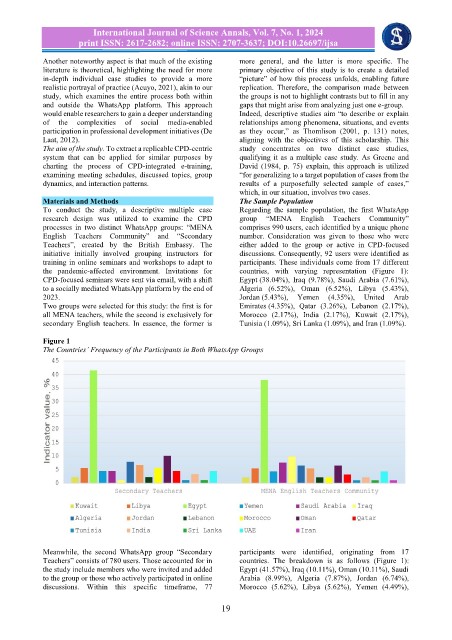
            the  pandemic-affected  environment.  Invitations  for   countries,  with  varying  representation  (Figure  1):
            CPD-focused seminars were sent via email, with a shift   Egypt (38.04%),  Iraq  (9.78%),  Saudi  Arabia  (7.61%),
            to a socially mediated WhatsApp platform by the end of   Algeria  (6.52%),  Oman  (6.52%),  Libya  (5.43%),
            2023.                                               Jordan (5.43%),  Yemen  (4.35%),  United  Arab
            Two groups were selected for this study: the first is for   Emirates (4.35%),  Qatar  (3.26%),  Lebanon  (2.17%),
            all MENA teachers, while the second is exclusively for   Morocco  (2.17%),  India  (2.17%),  Kuwait  (2.17%),
            secondary  English  teachers.  In  essence,  the  former  is   Tunisia (1.09%), Sri Lanka (1.09%), and Iran (1.09%).

            Figure 1
            The Countries’ Frequency of the Participants in Both WhatsApp Groups


            Meanwhile,  the  second  WhatsApp  group  “Secondary   participants  were  identified,  originating  from  17
            Teachers” consists of 780 users. Those accounted for in   countries.  The  breakdown  is  as  follows  (Figure  1):
            the study include members who were invited and added   Egypt (41.57%), Iraq (10.11%), Oman (10.11%), Saudi
            to the group or those who actively participated in online   Arabia  (8.99%),  Algeria  (7.87%),  Jordan  (6.74%),
            discussions.  Within  this  specific  timeframe,  77   Morocco  (5.62%),  Libya  (5.62%),  Yemen  (4.49%),

                                                           19

