


Page 32 - IJSA, Vol. 7, No 1, 2024
P. 32
International Journal of Science Annals, Vol. 7, No. 1, 2024
                      рrint ISSN: 2617-2682; online ISSN: 2707-3637; DOI:10.26697/ijsa

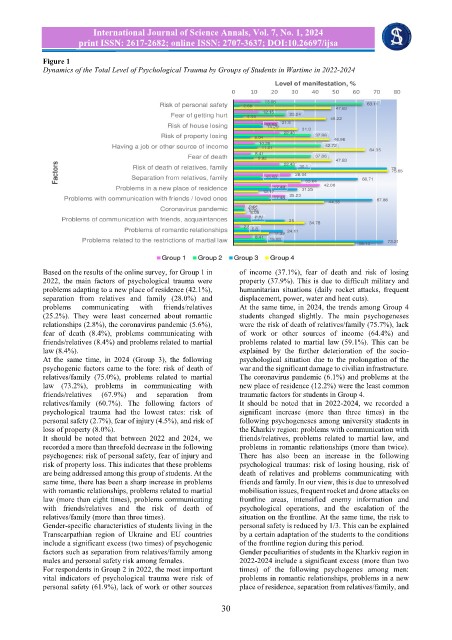
            Figure 1
            Dynamics of the Total Level of Psychological Trauma by Groups of Students in Wartime in 2022-2024


            Based on the results of the online survey, for Group 1 in   of  income  (37.1%),  fear  of  death  and  risk  of  losing
            2022,  the  main  factors  of  psychological  trauma  were   property (37.9%). This is due to difficult military and
            problems adapting to a new place of residence (42.1%),   humanitarian  situations  (daily  rocket  attacks,  frequent
            separation  from  relatives  and  family  (28.0%)  and   displacement, power, water and heat cuts).
            problems   communicating   with   friends/relatives   At the same time, in 2024, the trends among Group 4
            (25.2%).  They  were  least  concerned  about  romantic   students  changed  slightly.  The  main  psychogeneses
            relationships (2.8%), the coronavirus pandemic (5.6%),   were the risk of death of relatives/family (75.7%), lack
            fear  of  death  (8.4%),  problems  communicating  with   of  work  or  other  sources  of  income  (64.4%)  and
            friends/relatives (8.4%) and problems related to martial   problems  related  to  martial  law  (59.1%). This  can  be
            law (8.4%).                                         explained  by  the  further  deterioration  of  the  socio-
            At  the  same  time,  in  2024  (Group  3),  the  following   psychological situation due to the prolongation of the
            psychogenic factors came to the fore: risk of death of   war and the significant damage to civilian infrastructure.
            relatives/family  (75.0%),  problems  related  to  martial   The coronavirus pandemic (6.1%) and problems at the
            law  (73.2%),  problems  in  communicating  with    new place of residence (12.2%) were the least common
            friends/relatives   (67.9%)   and   separation   from   traumatic factors for students in Group 4.
            relatives/family  (60.7%).  The  following  factors  of   It  should  be  noted  that  in  2022-2024,  we  recorded  a
            psychological  trauma  had  the  lowest  rates:  risk  of   significant  increase  (more  than  three  times)  in  the
            personal safety (2.7%), fear of injury (4.5%), and risk of   following psychogeneses among university students in
            loss of property (8.0%).                            the Kharkiv region: problems with communication with
            It  should  be  noted  that  between  2022  and  2024,  we   friends/relatives,  problems  related  to  martial  law,  and
            recorded a more than threefold decrease in the following   problems in romantic relationships (more than twice).
            psychogenes: risk of personal safety, fear of injury and   There  has  also  been  an  increase  in  the  following
            risk of property loss. This indicates that these problems   psychological traumas: risk of losing  housing, risk of
            are being addressed among this group of students. At the   death  of  relatives  and  problems  communicating  with
            same time, there has been a sharp increase in problems   friends and family. In our view, this is due to unresolved
            with romantic relationships, problems related to martial   mobilisation issues, frequent rocket and drone attacks on
            law (more than eight times), problems communicating   frontline  areas,  intensified  enemy  information  and
            with  friends/relatives  and  the  risk  of  death  of   psychological  operations,  and  the  escalation  of  the
            relatives/family (more than three times).           situation on the frontline. At the same time, the risk to
            Gender-specific characteristics of students living in the   personal safety is reduced by 1/3. This can be explained
            Transcarpathian  region  of  Ukraine  and  EU  countries   by a certain adaptation of the students to the conditions
            include a significant excess (two times) of psychogenic   of the frontline region during this period.
            factors such as separation from relatives/family among   Gender peculiarities of students in the Kharkiv region in
            males and personal safety risk among females.       2022-2024 include a significant excess (more than two
            For respondents in Group 2 in 2022, the most important   times)  of  the  following  psychogenes  among  men:
            vital  indicators  of  psychological  trauma  were  risk  of   problems in romantic relationships, problems in a new
            personal safety (61.9%), lack of work or other sources   place of residence, separation from relatives/family, and

                                                           30

