


Page 34 - IJSA, Vol. 7, No 1, 2024
P. 34
International Journal of Science Annals, Vol. 7, No. 1, 2024
                      рrint ISSN: 2617-2682; online ISSN: 2707-3637; DOI:10.26697/ijsa

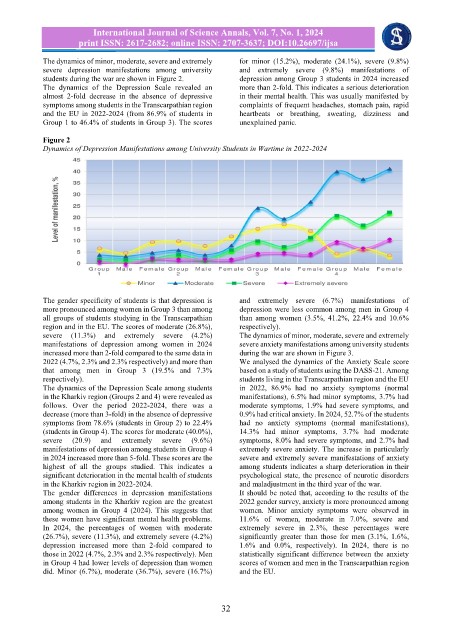
            The dynamics of minor, moderate, severe and extremely   for  minor  (15.2%),  moderate  (24.1%),  severe  (9.8%)
            severe  depression  manifestations  among  university   and  extremely  severe  (9.8%)  manifestations  of
            students during the war are shown in Figure 2.      depression among Group 3 students in 2024 increased
            The  dynamics  of  the  Depression  Scale  revealed  an   more than 2-fold. This indicates a serious deterioration
            almost  2-fold  decrease  in  the  absence  of  depressive   in their mental health. This was usually manifested by
            symptoms among students in the Transcarpathian region   complaints of frequent headaches, stomach pain, rapid
            and the EU in 2022-2024 (from 86.9% of students in   heartbeats  or  breathing,  sweating,  dizziness  and
            Group 1 to 46.4% of students in Group 3). The scores   unexplained panic.

            Figure 2
            Dynamics of Depression Manifestations among University Students in Wartime in 2022-2024


            The gender specificity of students is that depression is   and  extremely  severe  (6.7%)  manifestations  of
            more pronounced among women in Group 3 than among   depression were less common among men in Group 4
            all groups of students studying in the Transcarpathian   than  among  women  (3.5%,  41.2%,  22.4%  and  10.6%
            region and in the EU. The scores of moderate (26.8%),   respectively).
            severe  (11.3%)  and  extremely  severe  (4.2%)     The dynamics of minor, moderate, severe and extremely
            manifestations  of  depression  among  women  in  2024   severe anxiety manifestations among university students
            increased more than 2-fold compared to the same data in   during the war are shown in Figure 3.
            2022 (4.7%, 2.3% and 2.3% respectively) and more than   We analysed the dynamics of the Anxiety Scale score
            that  among  men  in  Group  3  (19.5%  and  7.3%   based on a study of students using the DASS-21. Among
            respectively).                                      students living in the Transcarpathian region and the EU
            The dynamics of the Depression Scale among students   in  2022,  86.9%  had  no  anxiety  symptoms  (normal
            in the Kharkiv region (Groups 2 and 4) were revealed as   manifestations), 6.5% had minor symptoms, 3.7% had
            follows.  Over  the  period  2022-2024,  there  was  a   moderate symptoms, 1.9% had severe symptoms, and
            decrease (more than 3-fold) in the absence of depressive   0.9% had critical anxiety. In 2024, 52.7% of the students
            symptoms from 78.6% (students in Group 2) to 22.4%   had  no  anxiety  symptoms  (normal  manifestations),
            (students in Group 4). The scores for moderate (40.0%),   14.3%  had  minor  symptoms,  3.7%  had  moderate
            severe   (20.9)   and   extremely   severe   (9.6%)   symptoms, 8.0% had severe symptoms, and 2.7% had
            manifestations of depression among students in Group 4   extremely  severe anxiety. The increase in particularly
            in 2024 increased more than 5-fold. These scores are the   severe and extremely severe manifestations of anxiety
            highest  of  all  the  groups  studied.  This  indicates  a   among students indicates a sharp deterioration in their
            significant deterioration in the mental health of students   psychological state, the presence of neurotic disorders
            in the Kharkiv region in 2022-2024.                 and maladjustment in the third year of the war.
            The  gender  differences  in  depression  manifestations   It should be noted that, according to the results of the
            among students in the Kharkiv region are the greatest   2022 gender survey, anxiety is more pronounced among
            among  women  in  Group  4  (2024). This  suggests  that   women.  Minor  anxiety  symptoms  were  observed  in
            these women have significant mental health problems.   11.6%  of  women,  moderate  in  7.0%,  severe  and
            In  2024,  the  percentages  of  women  with  moderate   extremely  severe  in  2.3%,  these  percentages  were
            (26.7%), severe (11.3%), and extremely severe (4.2%)   significantly  greater  than  those  for  men  (3.1%,  1.6%,
            depression  increased  more  than  2-fold  compared  to   1.6%  and  0.0%,  respectively).  In  2024,  there  is  no
            those in 2022 (4.7%, 2.3% and 2.3% respectively). Men   statistically  significant  difference  between  the  anxiety
            in Group 4 had lower levels of depression than women   scores of women and men in the Transcarpathian region
            did. Minor (6.7%), moderate (36.7%), severe (16.7%)   and the EU.


                                                           32

