


Page 46 - IJSA, Vol. 7, No 1, 2024
P. 46
International Journal of Science Annals, Vol. 7, No. 1, 2024
                      рrint ISSN: 2617-2682; online ISSN: 2707-3637; DOI:10.26697/ijsa

            the  internet  (North  et  al.,  2020;  Raimo  et  al.,  2023;   considered to be a good return (Salah & Ayyash, 2023).
            Spanò et al., 2023).                                The collected data were analyzed using SPSS version
            The  aim  of  the  study.  To  explore  and  explain   28. A reliability test was also conducted in this present
            digitalisation factors influencing the DC of SMEs in the   study. Scholarly work by Hall et al. (2023) states that the
            healthcare sector.                                  prime  reason  for  conducting  a  reliability  test  is  to
            To realize the aim, the research question was formulated   examine  the  level  of  consistency  of  the  survey
            as what are the digitalisation factors influencing the DC   questionnaire. A plethora of research (e.g., Dzomonda
            of SMEs in the healthcare sector?                   &  Fatoki,  2019;  Martinez-Corona  et  al.,  2020)  has
                                                                indicated that a questionnaire is considered reliable if
            Materials and Methods                               Cronbach’s  alpha  (CA)  is  greater  or  equal  to  0.7
            As  the  aim  of  this  present  study  was  to  explore  and   (Cheung  et  al.,  2023;  Ogujiuba  et  al.,  2023).  As
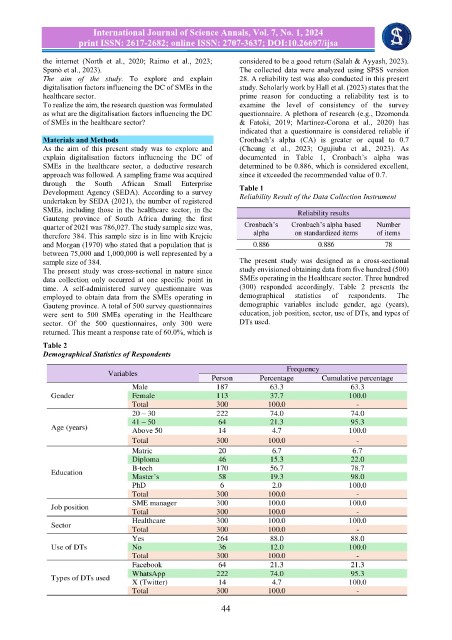
            explain  digitalisation  factors  influencing  the  DC  of   documented  in  Table  1,  Cronbach’s  alpha  was
            SMEs  in  the  healthcare  sector,  a  deductive  research   determined to be 0.886, which is considered excellent,
            approach was followed. A sampling frame was acquired   since it exceeded the recommended value of 0.7.
            through  the  South   African  Small  Enterprise
            Development Agency (SEDA). According to a survey    Table 1
                                                                Reliability Result of the Data Collection Instrument
            undertaken by SEDA (2021), the number of registered
            SMEs, including those in the healthcare sector, in the
            Gauteng  province  of  South  Africa  during  the  first
            quarter of 2021 was 786,027. The study sample size was,
            therefore 384. This sample size is in line with Krejcie
            and Morgan (1970) who stated that a population that is
            between 75,000 and 1,000,000 is well represented by a
            sample size of 384.                                 The  present  study  was  designed  as  a  cross-sectional
            The  present  study  was  cross-sectional  in  nature  since   study envisioned obtaining data from five hundred (500)
            data  collection  only  occurred  at  one  specific  point  in   SMEs operating in the Healthcare sector. Three hundred
            time.  A  self-administered  survey  questionnaire  was   (300) responded  accordingly.  Table  2  presents  the
            employed  to  obtain  data  from  the  SMEs  operating  in   demographical   statistics   of   respondents.   The
            Gauteng province. A total of 500 survey questionnaires   demographic  variables  include  gender,  age  (years),
            were  sent  to  500  SMEs  operating  in  the  Healthcare   education, job position, sector, use of DTs, and types of
            sector.  Of  the  500  questionnaires,  only  300  were   DTs used.
            returned. This meant a response rate of 60.0%, which is
            Table 2
            Demographical Statistics of Respondents


                                                           44

