


Page 47 - IJSA, Vol. 7, No 1, 2024
P. 47
International Journal of Science Annals, Vol. 7, No. 1, 2024
                      рrint ISSN: 2617-2682; online ISSN: 2707-3637; DOI:10.26697/ijsa

            As  shown  in  Table  63.3%  (187)  of  participants   Furthermore,  Table  2  shows  that  74.0%  (222)  of
            representing healthcare SMEs were males, whilst 37.7%   participants use WhatsApp, 21.3% (64) use Facebook,
            (113) were females. Furthermore, the findings in Table  and 4.7% (14) use X (formerly Twitter).
            2 reveal that 74.0% (222) of participants were between  Regression Analysis
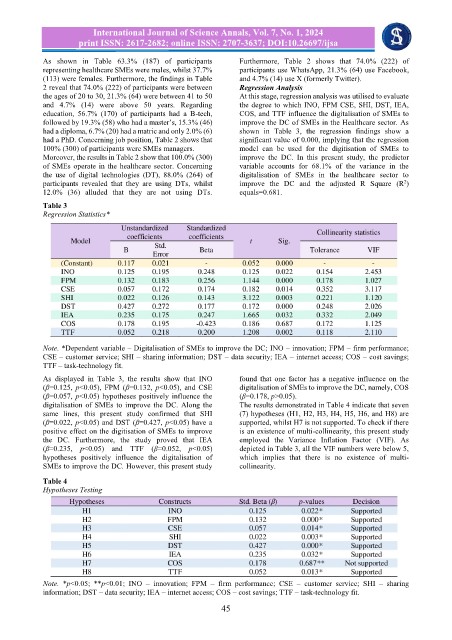
            the ages of 20 to 30, 21.3% (64) were between 41 to 50  At this stage, regression analysis was utilised to evaluate
            and  4.7%  (14)  were  above  50  years.  Regarding  the degree to which INO, FPM CSE, SHI, DST, IEA,
            education,  56.7%  (170)  of  participants  had  a  B-tech,  COS, and TTF influence the digitalisation of SMEs to
            followed by 19.3% (58) who had a master’s, 15.3% (46)  improve the DC of SMEs in the Healthcare sector. As
            had a diploma, 6.7% (20) had a matric and only 2.0% (6)  shown  in  Table  3,  the  regression  findings  show  a
            had a PhD. Concerning job position, Table 2 shows that  significant value of 0.000, implying that the regression
            100% (300) of participants were SMEs managers.      model  can  be  used  for  the  digitisation  of  SMEs  to
            Moreover, the results in Table 2 show that 100.0% (300)  improve  the  DC.  In  this  present  study,  the  predictor
            of SMEs operate in the healthcare sector. Concerning  variable  accounts  for  68.1%  of  the  variance  in  the
            the  use  of  digital  technologies  (DT),  88.0%  (264)  of  digitalisation  of  SMEs  in  the  healthcare  sector  to
                                                                                                           2
            participants  revealed  that  they  are  using  DTs,  whilst  improve  the  DC  and  the  adjusted  R  Square  (R )
            12.0%  (36)  alluded  that  they  are  not  using  DTs.  equals=0.681.
            Table 3
            Regression Statistics*


            Note. *Dependent variable – Digitalisation of SMEs to improve the DC; INO – innovation; FPM – firm performance;
            CSE – customer service; SHI – sharing information; DST – data security; IEA – internet access; COS – cost savings;
            TTF – task-technology fit.

            As  displayed  in  Table  3,  the  results  show  that  INO   found  that  one  factor  has  a  negative  influence  on  the
            (β=0.125,  p<0.05),  FPM  (β=0.132,  p<0.05),  and  CSE   digitalisation of SMEs to improve the DC, namely, COS
            (β=0.057,  p<0.05) hypotheses positively influence the   (β=0.178, p>0.05).
            digitalisation of SMEs to improve the DC. Along the   The results demonstrated in Table 4 indicate that seven
            same  lines,  this  present  study  confirmed  that  SHI   (7) hypotheses (H1, H2, H3, H4, H5, H6, and H8) are
            (β=0.022, p<0.05) and DST (β=0.427, p<0.05) have a   supported, whilst H7 is not supported. To check if there
            positive effect on the digitisation of SMEs to improve   is an existence of multi-collinearity, this present study
            the  DC.  Furthermore,  the  study  proved  that  IEA   employed  the  Variance  Inflation  Factor  (VIF).  As
            (β=0.235,  p<0.05)  and  TTF  (β=0.052,  p<0.05)    depicted in Table 3, all the VIF numbers were below 5,
            hypotheses  positively  influence  the  digitalisation  of   which  implies  that  there  is  no  existence  of  multi-
            SMEs to improve the DC. However, this present study   collinearity.
            Table 4
            Hypotheses Testing


            Note.  *p<0.05;  **p<0.01;  INO  –  innovation;  FPM  –  firm  performance;  CSE  –  customer  service;  SHI  –  sharing
            information; DST – data security; IEA – internet access; COS – cost savings; TTF – task-technology fit.
                                                           45

