


Page 48 - IJSA, Vol. 7, No 1, 2024
P. 48
International Journal of Science Annals, Vol. 7, No. 1, 2024
                      рrint ISSN: 2617-2682; online ISSN: 2707-3637; DOI:10.26697/ijsa

            Results and Discussion
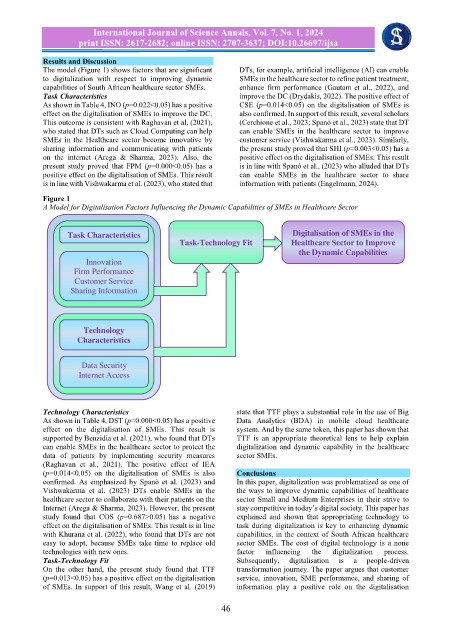
            The model (Figure 1) shows factors that are significant   DTs, for example, artificial intelligence (AI) can enable
            to  digitalization  with  respect  to  improving  dynamic   SMEs in the healthcare sector to refine patient treatment,
            capabilities of South African healthcare sector SMEs.   enhance  firm  performance  (Gautam  et  al.,  2022),  and
            Task Characteristics                                improve the DC (Drydakis, 2022). The positive effect of
            As shown in Table 4, INO (p=0.022<0.05) has a positive   CSE  (p=0.014<0.05)  on  the digitalisation  of  SMEs  is
            effect on the digitalisation of SMEs to improve the DC.   also confirmed. In support of this result, several scholars
            This outcome is consistent with Raghavan et al. (2021),   (Cerchione et al., 2023; Spanò et al., 2023) state that DT
            who stated that DTs such as Cloud Computing can help   can  enable  SMEs  in  the  healthcare  sector  to  improve
            SMEs  in  the  Healthcare  sector  become  innovative  by   customer service (Vishwakarma et al., 2023). Similarly,
            sharing  information  and  communicating  with  patients   the present study proved that SHI (p=0.003<0.05) has a
            on  the  internet  (Arega  &  Sharma,  2023).  Also,  the   positive effect on the digitalisation of SMEs. This result
            present  study  proved  that  FPM  (p=0.000<0.05)  has  a   is in line with Spanò et al., (2023) who alluded that DTs
            positive effect on the digitalisation of SMEs. This result   can  enable  SMEs  in  the  healthcare  sector  to  share
            is in line with Vishwakarma et al. (2023), who stated that   information with patients (Engelmann, 2024).
            Figure 1
            A Model for Digitalisation Factors Influencing the Dynamic Capabilities of SMEs in Healthcare Sector


            Technology Characteristics                         state that TTF plays a substantial role in the use of Big
            As shown in Table 4, DST (p=0.000<0.05) has a positive   Data  Analytics  (BDA)  in  mobile  cloud  healthcare
            effect  on  the  digitalisation  of  SMEs.  This  result  is   system. And by the same token, this paper has shown that
            supported by Benzidia et al. (2021), who found that DTs   TTF  is  an  appropriate  theoretical  lens  to  help  explain
            can enable SMEs in the healthcare sector to protect the   digitalization  and  dynamic  capability  in  the  healthcare
            data  of  patients  by  implementing  security  measures   sector SMEs.
            (Raghavan  et  al.,  2021).  The  positive  effect  of  IEA
            (p=0.014<0.05)  on  the  digitalisation  of  SMEs  is  also   Conclusions
            confirmed.  As emphasized by Spanò et al. (2023) and   In this paper, digitalization was problematized as one of
            Vishwakarma  et  al.  (2023)  DTs  enable  SMEs  in  the   the ways to improve dynamic capabilities of healthcare
            healthcare sector to collaborate with their patients on the   sector Small and Medium Enterprises in their strive to
            Internet (Arega & Sharma, 2023). However, the present   stay competitive in today’s digital society. This paper has
            study  found  that  COS  (p=0.687>0.05)  has  a  negative   explained  and  shown  that  appropriating  technology  to
            effect on the digitalisation of SMEs. This result is in line   task during digitalization is key to enhancing dynamic
            with Khurana et al. (2022), who found that DTs are not   capabilities, in the context of South African healthcare
            easy  to  adopt,  because  SMEs  take  time  to  replace  old   sector SMEs. The cost of digital technology is a none
            technologies with new ones.                        factor   influencing   the   digitalization   process.
            Task-Technology Fit                                Subsequently,   digitalisation   is   a   people-driven
            On  the  other  hand,  the  present  study  found  that  TTF   transformation journey. The paper argues that customer
            (p=0.013<0.05) has a positive effect on the digitalisation   service,  innovation,  SME  performance,  and  sharing  of
            of SMEs. In support of this result, Wang et al. (2019)   information  play  a  positive  role  on  the  digitalisation

                                                           46

