


Page 55 - IJSA, Vol. 7, No 1, 2024
P. 55
International Journal of Science Annals, Vol. 7, No. 1, 2024
                      рrint ISSN: 2617-2682; online ISSN: 2707-3637; DOI:10.26697/ijsa

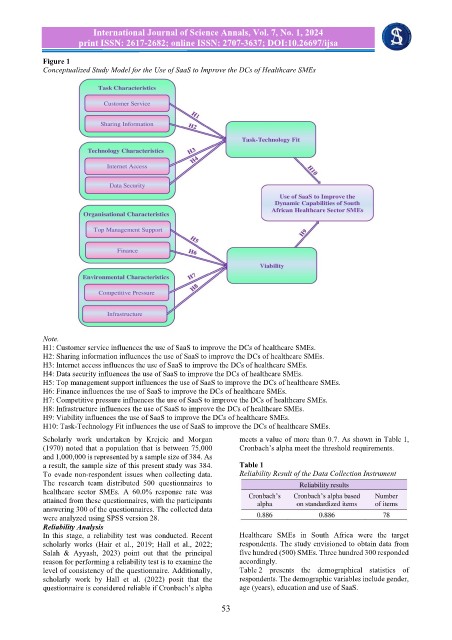
            Figure 1
            Conceptualized Study Model for the Use of SaaS to Improve the DCs of Healthcare SMEs


            Note.
            H1: Customer service influences the use of SaaS to improve the DCs of healthcare SMEs.
            H2: Sharing information influences the use of SaaS to improve the DCs of healthcare SMEs.
            H3: Internet access influences the use of SaaS to improve the DCs of healthcare SMEs.
            H4: Data security influences the use of SaaS to improve the DCs of healthcare SMEs.
            H5: Top management support influences the use of SaaS to improve the DCs of healthcare SMEs.
            H6: Finance influences the use of SaaS to improve the DCs of healthcare SMEs.
            H7: Competitive pressure influences the use of SaaS to improve the DCs of healthcare SMEs.
            H8: Infrastructure influences the use of SaaS to improve the DCs of healthcare SMEs.
            H9: Viability influences the use of SaaS to improve the DCs of healthcare SMEs.
            H10: Task-Technology Fit influences the use of SaaS to improve the DCs of healthcare SMEs.

            Scholarly  work  undertaken  by  Krejcie  and  Morgan   meets a value of more than 0.7. As shown in Table 1,
            (1970) noted that a population that is between 75,000   Cronbach’s alpha meet the threshold requirements.
            and 1,000,000 is represented by a sample size of 384. As
            a result, the sample size of this present study was 384.   Table 1
            To evade non-respondent issues when collecting data.   Reliability Result of the Data Collection Instrument
            The  research  team  distributed  500  questionnaires  to
            healthcare  sector  SMEs.  A  60.0%  response  rate  was
            attained from these questionnaires, with the participants
            answering 300 of the questionnaires. The collected data
            were analyzed using SPSS version 28.
            Reliability Analysis
            In  this  stage,  a  reliability  test  was  conducted.  Recent   Healthcare  SMEs  in  South  Africa  were  the  target
            scholarly  works  (Hair  et  al.,  2019;  Hall  et  al.,  2022;   respondents. The study envisioned to obtain data from
            Salah  &  Ayyash,  2023)  point  out  that  the  principal   five hundred (500) SMEs. Three hundred 300 responded
            reason for performing a reliability test is to examine the   accordingly.
            level of consistency of the questionnaire. Additionally,   Table 2  presents  the  demographical  statistics  of
            scholarly  work  by  Hall  et  al.  (2022)  posit  that  the   respondents. The demographic variables include gender,
            questionnaire is considered reliable if Cronbach’s alpha   age (years), education and use of SaaS.

                                                           53

