


Page 57 - IJSA, Vol. 7, No 1, 2024
P. 57
International Journal of Science Annals, Vol. 7, No. 1, 2024
                      рrint ISSN: 2617-2682; online ISSN: 2707-3637; DOI:10.26697/ijsa

            Table 4
            Hypotheses Testing


            Note. *p<0.05; **p<0.01; CUS – customer service; SHI – sharing information; IEA – internet access; DAS – data security;
            TMS – top management support; FIC – finance; CMP – competitive pressure; IFT – infrastructure; VAB – viability; TTF
            – task-technology fit.
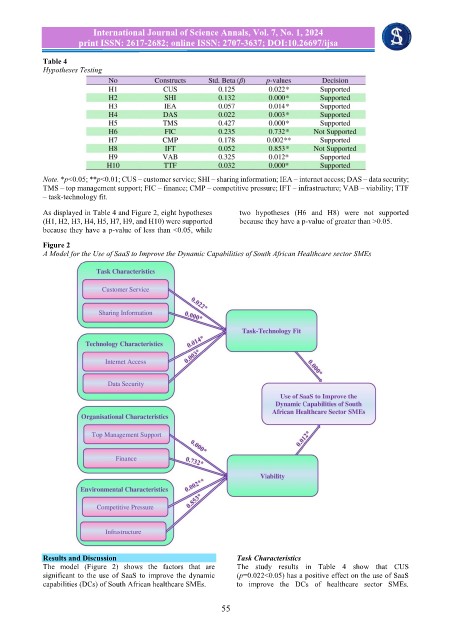
            As displayed in Table 4 and Figure 2, eight hypotheses   two  hypotheses  (H6  and  H8)  were  not  supported
            (H1, H2, H3, H4, H5, H7, H9, and H10) were supported   because they have a p-value of greater than >0.05.
            because they have a p-value of less than <0.05, while

            Figure 2
            A Model for the Use of SaaS to Improve the Dynamic Capabilities of South African Healthcare sector SMEs


            Results and Discussion                             Task Characteristics
            The  model  (Figure  2)  shows  the  factors  that  are   The  study  results  in  Table  4  show  that  CUS
            significant to the use of SaaS to improve the dynamic   (p=0.022<0.05) has a positive effect on the use of SaaS
            capabilities (DCs) of South African healthcare SMEs.    to  improve  the  DCs  of  healthcare  sector  SMEs.


                                                           55

