


Page 56 - IJSA, Vol. 7, No 1, 2024
P. 56
International Journal of Science Annals, Vol. 7, No. 1, 2024
                      рrint ISSN: 2617-2682; online ISSN: 2707-3637; DOI:10.26697/ijsa

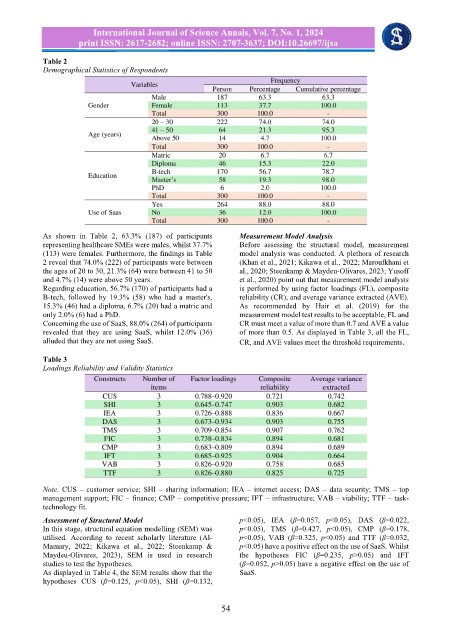
            Table 2
            Demographical Statistics of Respondents


            As  shown  in  Table  2,  63.3%  (187)  of  participants   Measurement Model Analysis
            representing healthcare SMEs were males, whilst 37.7%   Before  assessing  the  structural  model,  measurement
            (113) were females. Furthermore, the findings in Table  model analysis was conducted. A plethora of research
            2 reveal that 74.0% (222) of participants were between  (Khan et al., 2021; Kikawa et al., 2022; Maroufkhani et
            the ages of 20 to 30, 21.3% (64) were between 41 to 50  al., 2020; Steenkamp & Maydeu-Olivares, 2023; Yusoff
            and 4.7% (14) were above 50 years.                  et al., 2020) point out that measurement model analysis
            Regarding education, 56.7% (170) of participants had a  is performed by using factor loadings (FL), composite
            B-tech,  followed  by  19.3%  (58)  who  had  a  master's,  reliability (CR), and average variance extracted (AVE).
            15.3% (46) had a diploma, 6.7% (20) had a matric and  As  recommended  by  Hair  et  al.  (2019)  for  the
            only 2.0% (6) had a PhD.                            measurement model test results to be acceptable, FL and
            Concerning the use of SaaS, 88.0% (264) of participants  CR must meet a value of more than 0.7 and AVE a value
            revealed  that  they  are  using  SaaS,  whilst  12.0%  (36)  of more than 0.5. As displayed in Table 3, all the FL,
            alluded that they are not using SaaS.               CR, and AVE values meet the threshold requirements.

            Table 3
            Loadings Reliability and Validity Statistics


            Note. CUS – customer service; SHI – sharing information; IEA  – internet access; DAS – data security; TMS – top
            management support; FIC – finance; CMP – competitive pressure; IFT – infrastructure; VAB – viability; TTF – task-
            technology fit.
            Assessment of Structural Model                      p<0.05),  IEA  (β=0.057,  p<0.05),  DAS  (β=0.022,
            In this stage, structural equation modelling (SEM) was   p<0.05),  TMS  (β=0.427,  p<0.05),  CMP  (β=0.178,
            utilised.  According  to  recent  scholarly  literature  (Al-  p<0.05),  VAB  (β=0.325,  p<0.05)  and  TTF  (β=0.032,
            Mamary,  2022;  Kikawa  et  al.,  2022;  Steenkamp  &   p<0.05) have a positive effect on the use of SaaS. Whilst
            Maydeu-Olivares,  2023),  SEM  is  used  in  research   the  hypotheses  FIC  (β=0.235,  p>0.05)  and  IFT
            studies to test the hypotheses.                     (β=0.052, p>0.05) have a negative effect on the use of
            As displayed in Table 4, the SEM results show that the   SaaS.
            hypotheses  CUS  (β=0.125,  p<0.05),  SHI  (β=0.132,


                                                           54

